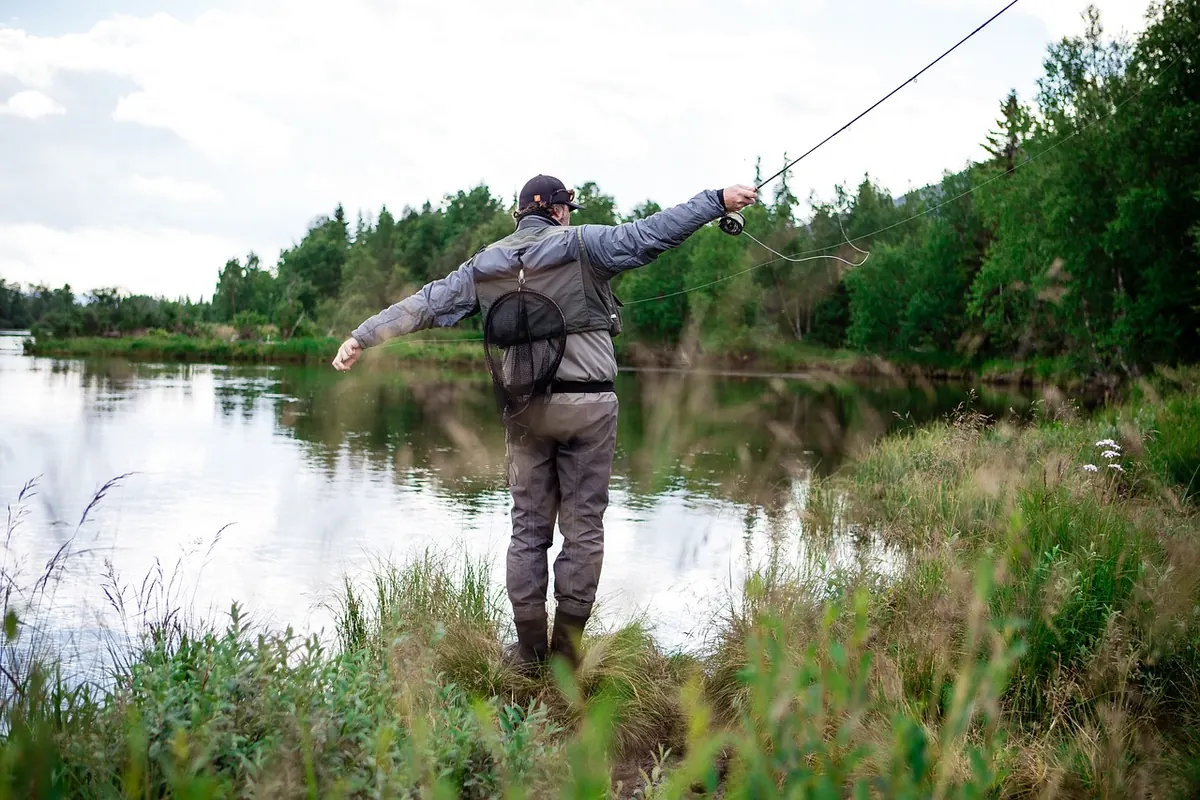
Every fly fisher has stood in a river and watched a beautiful cast end in a tangle. The reassuring part is that casting faults are not random and they are rarely about talent. A fly cast is a straight-line system: the rod tip travels a straight path, the pause lasts long enough for the line to straighten, and the power arrives smoothly. Break one of those three and the loop in the air tells you exactly which one you broke — if you know how to read it.
Tailing Loops: When the Two Legs Cross
A tailing loop is the fault most of us meet first. Instead of a tidy oval, the top leg of the loop dives down and crosses the bottom leg, and if things go badly you get a wind knot in the leader. It nearly always comes from one of two habits: a sudden jab of power at the end of the stroke, or the rod tip dropping below the straight-line path it should be following.
What to look for
Cast with the rod held low and to the side, so you can watch the loop against the sky rather than guessing from the splash. If the loop crosses, slow the acceleration and check that your rod tip is not dipping as you finish.
Creep: The Fault You Cannot Feel
Creep is a slow, unconscious forward drift of the rod after you have stopped the back cast. Nobody thinks they do it. It quietly steals the length of your casting arc, so when you start forward there is less room to load the rod and the line is not yet straight behind you. The result is a cast that looks fine until the last moment and then collapses into a tail or falls short.
The fix is almost insultingly simple: after the stop, hold the rod still. Freeze it. Count a beat out loud — "stop, one, cast" — until the habit fades. If your back cast starts to improve the moment you say it aloud, creep was your problem.
Rushed Timing and Too Much Power
Power is not distance. The line travels because the rod tip stops crisply and the loop stays tight, not because you swing harder. Rushing the stroke — starting forward before the back cast has unrolled — means you are pulling against a loop that is still travelling away from you. The instinct is to add more force to compensate, which opens the loop further and shortens the cast.
Give the line longer than feels natural to straighten behind you. Keep six to eight metres of line in the air until that loop is clean every time, then add two metres, then another two. There is no fixed count for the pause; the longer the line, the longer the pause, and the only reliable judge is whether the line has straightened.
Wide Loops and Poor Rod Tracking
A wide, floppy loop loses energy and struggles in wind. Two causes dominate. The first is tracking: if the rod tip wanders off to the side instead of travelling in a vertical plane, the loop opens and curves. The second is using a casting arc that is far too wide for the amount of line you are carrying — if the rod is barely bending, the tip does not need to sweep from horizon to horizon.
- Check the path: cast along a path edge or a painted line and keep the rod tip above it in both directions. Turn your head to watch the back cast instead of trusting your shoulder.
- Match arc to load: short line, short arc. Let the bend in the rod tell you how far to travel.
- Watch the elbow: if it drifts away from your body, the rod follows it and the loop opens.
A Broken Wrist and a Dropped Rod Tip
Two small movements ruin a lot of casts. The first is wrist break: the rod hinges backwards at the end of the stroke, so the tip travels in a curve and there is never a proper stop. Hold the rod with the thumb on top and treat the forearm and wrist as one unit, with only a slight flex at the finish.
The second is dropping the tip after the stop. Lowering the rod lets the line fall into slack, and slack is what makes a cast land in a pile. Finish the forward cast with the tip high and the line straight, and only lower the rod deliberately when you are presenting the fly or mending line.
Line Management and the Haul
Plenty of "casting faults" are really line-handling faults. Line coiled around your feet, trapped under a boot or looped over the reel cannot shoot, and slack line in the air will destroy any loop, however good your timing is.
Keep the line hand low and tidy, feeding line out in small amounts rather than in great coils. With the double haul, pull on the line as the rod loads and let it slide back as you reverse direction — the timing matters far more than the force. A firm grip helps too; white knuckles tire you out and stiffen the stroke.
Five Drills to Iron Out the Faults
- Pick-up-and-lay-down on grass. Eight to ten metres of line, no false casting. Aim for a loop with a visible gap between the two legs.
- Side-on loop watching. Cast at eye level so you can see the loop shape on every stroke, not just the good ones.
- The frozen stop. Pause after every back cast, check that the line has straightened, then cast forward. Slow and deliberate beats fast and wrong.
- Haul repetitions. Short line, no distance ambitions — simply rehearse the pull-and-release timing until it feels unhurried.
- Casting along a line. Use a painted line or a path edge, and cast in both directions to expose tracking errors you cannot feel.
Ten focused minutes with these drills will do more than an afternoon of hopeful flailing. Film a few casts on your phone and watch them back — faults you cannot feel in the hand are usually obvious on screen. Fix one thing at a time: a clean, tight loop at eight metres is worth far more than a heroic effort at twenty.
Photo: StockSnap / Pixabay